Wing Solar
What Is the Best Direction for Solar Panels in 2026? The answer depends on your roof, local weather, and when your home uses electricity. In the Northern Hemisphere, south-facing panels often produce the most energy across the year. But “most energy” does not always mean the best fit for your household. An east-facing array may catch the morning sun, while west-facing panels can produce more power later in the day.
For a practical compass reference, NREL’s PVWatts documentation, associated with solar engineer Aron Dobos, states: “180 degrees is south.” PVWatts estimates a system’s output using its location, tilt, and azimuth. NREL’s Annual Technology Baseline and Lawrence Berkeley National Laboratory’s Tracking the Sun report also provide useful industry context on solar performance, system design, and market trends. These sources help frame the decision, but they cannot replace a site-specific assessment. Shade from a chimney can matter more than a small change in panel direction.
So, What is the best direction for solar setup? Start with your roof’s clear, unshaded area, then compare estimated production against your utility’s rates and your household’s usage schedule. An installer can model those details with your roof dimensions and local weather data. Ask to see the assumptions. Estimates are not guarantees. And one detail is easy to miss: the best direction on paper may not be the best choice for a roof that needs repairs or has afternoon shade. That deserves a second look.
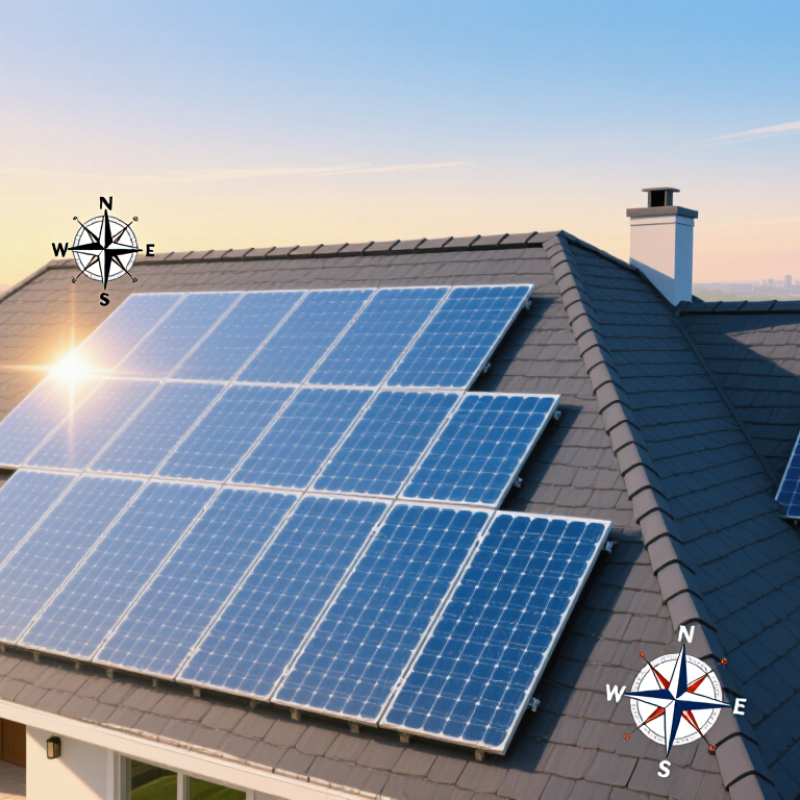
Panel direction shapes both how much electricity a system produces and when that power arrives. In the Northern Hemisphere, unobstructed, south-facing panels often capture strong annual sunlight. In the Southern Hemisphere, north-facing panels usually have the comparable advantage. Local latitude, roof pitch, and shade still matter. Direction is not a universal setting.
An east-facing array receives more direct light in the morning; a west-facing array tends to produce more later in the day. Their daily peaks may be lower than a well-oriented, unshaded array’s, but their output can better match a household’s morning or evening use. Picture a west-facing roof after work: panels may still be generating as lights and kitchen appliances come on. That timing can matter as much as the daily total.
A compass reading alone can mislead. Solar designs use azimuth, and magnetic north may differ from true north; roof angles and chimneys also change the practical result. Even a south-facing roof can lose production when a nearby tree casts a sharp afternoon shadow. A site-specific shade assessment and a comparison of expected hourly output give a more dependable answer than a single direction rule. The neat rule is useful, but incomplete.
In the Northern Hemisphere, solar panels generally perform best when they face south, toward the equator. This orientation usually captures strong sunlight around midday. A useful baseline. The exact angle still matters: latitude, roof pitch, and nearby shade all affect output. A chimney shadow crossing one panel can reduce production more than a small directional error.
In the Southern Hemisphere, the usual equator-facing direction is north. Panels aimed north often receive steady midday sun, but a north-facing roof is not automatically the best available surface. East-facing panels can produce more power in the morning, while west-facing panels may better match late-day household use. Across equatorial regions, east–west layouts can also make sense because the sun’s path shifts through the year.
Real roofs are rarely perfect. A roof may face northeast, sit beneath a tree, or have limited space. In those cases, a modestly off-direction array can still be worthwhile, though its output may differ from an ideal setup. Compare the roof’s usable area, seasonal shade, and local sun path before choosing. Check orientation with a site assessment rather than relying only on a phone compass; magnetic north and true north are not always the same. My first instinct would be to point panels toward the equator, but the roof’s actual conditions deserve the final say.
How East-, West-, and Equator-Facing Arrays Compare
In the Northern Hemisphere, south-facing panels usually capture the most sunlight across the year. In the Southern Hemisphere, the equivalent direction is north. This equator-facing setup often favors total annual energy, especially when panels have a suitable tilt and little shading. But it is not a universal winner. A chimney’s shadow or a low roof pitch can change the result.
East-facing arrays tend to produce more power in the morning, while west-facing arrays shift production later. That timing can suit households that use more electricity before work or after school. East-west layouts may also fit shallow roofs well, though their total annual output can be lower than a well-positioned equator-facing array. The difference depends on location, roof angle, weather, and nearby shade. I would not treat direction alone as a reliable forecast; it is easy to overlook how real roofs behave.
Tips: Check roof shade at different times of day, not just at noon. Compare expected production with your household’s usage pattern and local electricity rates. Ask for estimates based on your actual roof. Small details matter.
Panel direction is not a universal rule; location, roof design, shade, and household routines all matter. In the Northern Hemisphere, panels often produce well when they face south, but east- or west-facing arrays can suit a home better. A south-facing roof may catch strong midday sun, while an east-facing section can generate more power in the morning. The best fit depends on when electricity is used and how the local utility credits exported energy.
Roof shape matters. On a steep roof with several faces, the largest usable surface may not face south. An east-west layout can spread generation across more hours, though its total output may differ from a south-facing system. Nearby trees, chimneys, and dormers can cast moving shadows across panels. Even a narrow shadow can affect output, so shade should be checked at different times of day and across seasons. Small details count.
Daily energy use can change the preferred direction. A household that runs appliances in the afternoon may benefit from west-facing panels, while morning-heavy use may favor an eastern roof. Review a year of electricity bills rather than guessing from one month. A tidy, south-facing design is not automatically the best one. A qualified site assessment can compare roof faces, shading, and expected production; estimates still carry some uncertainty.
Estimated annual energy yield by panel direction in the Northern Hemisphere
South-facing panels generally produce the most annual energy in the Northern Hemisphere. East- and west-facing panels can still be effective, especially when their production better matches morning or evening electricity use. These figures are illustrative estimates for fixed, unshaded panels; roof pitch, location, shade, and system design affect actual output.
For a 2026 installation, choose direction based on your location, roof, and electricity-use pattern. In the Northern Hemisphere, south-facing panels usually capture the most annual sunlight; in the Southern Hemisphere, north-facing panels typically do. East-facing arrays produce more power earlier, while west-facing arrays can better match late-afternoon demand. That is not a rule. Nearby trees, chimneys, and winter shade can change the result.
Use a site-specific comparison before committing. NREL’s PVWatts Version 8 documentation shows how entering location, tilt, and azimuth produces monthly and annual AC-energy estimates using local weather data. Compare your actual roof planes, not just an ideal south-facing setup. A west-facing roof may deliver less annual energy but more useful power when household use peaks. I would still check the assumptions carefully; a clean model cannot fully capture a new tree or a neighbor’s future construction.
Tips: Measure your roof. Record shading at different times, then compare each usable direction in PVWatts. Ask an installer for the estimated annual output and key assumptions in writing. If the best-facing roof plane is small, a larger east-west layout may be the more practical choice. (Source: NREL, PVWatts Version 8 documentation.)
| Location or Situation | Recommended Direction | What to Expect | Practical Guidance |
|---|---|---|---|
| Northern Hemisphere | Generally toward true south | South-facing panels typically receive strong sunlight across the day and are a common choice for maximizing annual output on a fixed array. | Check the roof’s compass direction and shade conditions. Magnetic compass readings may differ from true-north-based azimuth measurements. |
| Southern Hemisphere | Generally toward true north | North-facing panels typically receive strong sunlight across the day and are a common choice for maximizing annual output on a fixed array. | Compare available roof faces and shading; the best practical layout may differ from the ideal direction. |
| East-facing roof | East, or toward the equator when feasible | Panels tend to produce more of their daily energy in the morning and less in the late afternoon than equator-facing panels. | Can suit households that use more electricity in the morning. The value of this timing depends on local electricity rates and household use. |
| West-facing roof | West, or toward the equator when feasible | Panels tend to produce more of their daily energy in the afternoon and early evening than east-facing panels. | May align better with afternoon or evening electricity use. Compare the expected energy profile with local rates and consumption. |
| East- and west-facing roof faces | Use both faces when a single ideal-facing roof area is limited | A split layout can spread generation across more hours, although each face may produce less annual energy per panel than an optimally oriented face. | Have the installer assess roof space, shading, system design, and expected production for each face. |
| Roof direction is fixed | Use the best unshaded roof face available | Roof pitch, obstructions, and shade can matter as much as direction. A less-than-ideal direction can still be suitable for solar. | Request a site-specific estimate that accounts for nearby trees, chimneys, buildings, and seasonal shade. |
| Choosing tilt as well as direction | Set tilt based on location and roof design | The tilt that best supports annual production depends on latitude and local conditions; a roof-mounted system often follows the existing roof pitch. | There is no single tilt angle that is best everywhere. Ask for modeled production at the proposed direction and tilt. |
| Azimuth reference | Describe direction using a stated convention | In a common azimuth convention, 0° is north, 90° east, 180° south, and 270° west. | Confirm whether a design uses true or magnetic north and which azimuth convention is being reported before comparing estimates. |
South-facing panels often capture strong midday sunlight. This is a useful baseline, not a guarantee. Roof pitch and shade can change the result.
North-facing panels often receive strong midday sun. A shaded northern roof may still perform worse than a clear roof facing another direction.
East-facing panels tend to generate more power in the morning. West-facing panels often produce more later in the day. The daily total may be lower.
Yes. Morning appliance use may suit an eastern roof, while evening cooking may align better with western panels. Timing matters.
The largest usable roof face may not point toward the equator. An east-west layout can spread production across more hours, though its total may differ.
Trees, chimneys, and dormers can cast moving shadows. Even a narrow shadow may reduce output. Check the roof at different times and seasons.
Not always. Magnetic north can differ from true north, and a compass cannot show seasonal shade. A site assessment gives a fuller picture.
Review a year of electricity bills, usable roof area, shade, and expected hourly production. Estimates still carry uncertainty. I might trust a tidy rule too much.
Choosing the right direction for solar panels can significantly affect how much electricity a home produces throughout the year. In the Northern Hemisphere, south-facing panels generally receive strong, consistent sunlight, while north-facing panels are often more productive in the Southern Hemisphere. East-facing arrays tend to generate more power in the morning, and west-facing arrays produce more later in the day. Equator-facing setups are often a useful starting point, but the best orientation depends on local sunlight and the household’s energy needs.
Roof shape, nearby shade, and available installation space can make a less-than-ideal direction the most practical choice. A roof’s pitch and obstacles such as trees or buildings may influence output more than orientation alone. Homeowners should also consider when they use electricity: east- or west-facing panels may better match morning or evening demand. Asking “What is the best direction for solar setup” means weighing these factors together rather than relying on one universal answer. A careful assessment can help guide a well-suited 2026 installation.
